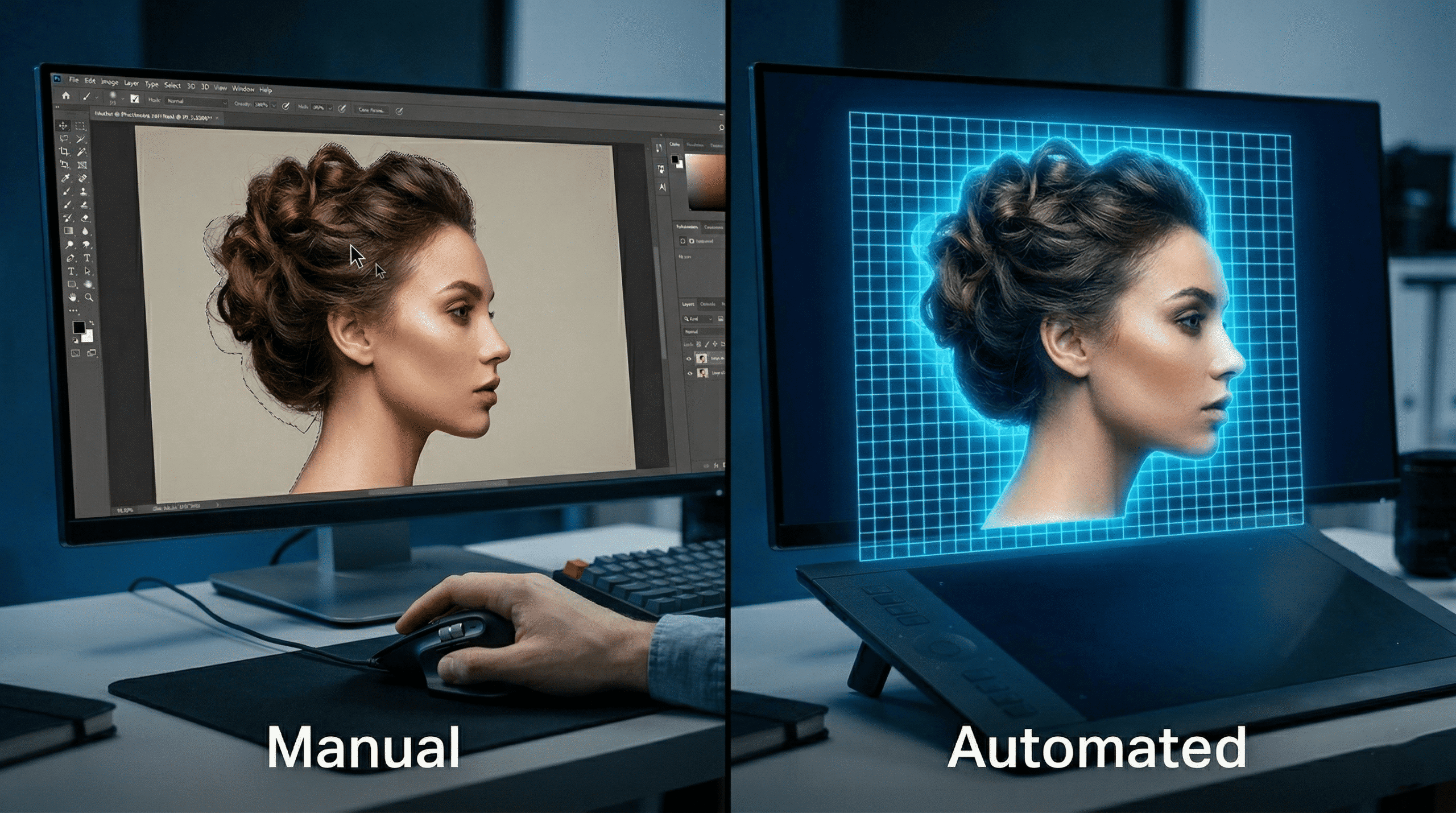
Photo masking is a vital technique in professional image editing, especially for industries like fashion, jewelry, e-commerce, and advertising. Businesses that rely on product photography know that flawless visuals are essential for attracting customers. This is exactly where professional Image masking services become necessary. However, when choosing between manual photo masking and automated masking, brands frequently struggle to decide which option delivers the optimal results.
Choosing between human precision and AI speed dictates the visual quality of your entire product catalog. Ultimately, Manual vs. Automated Photo Masking is the choice between exact edge precision and rapid, algorithm-driven object separation, because different commercial projects require specific balances of premium image quality and cost-effective bulk processing.
Why Do Professional Photo Masking Services Matter for Business?
Clean, distraction-free images directly impact consumer purchasing decisions and conversion rates. Industries like the fashion industry, jewelry business, and online retailers rely on realistic image masking to build brand trust, showcase exact product details, and meet strict marketplace compliance.
In commercial product photography, the core dilemma always centers on resource allocation. Creative agencies and e-commerce managers must navigate the choice between manual masking precision—which requires time and skilled labor—and AI-powered automated speed, which drastically reduces costs but carries specific quality risks.
How Does Manual Photo Masking Work?
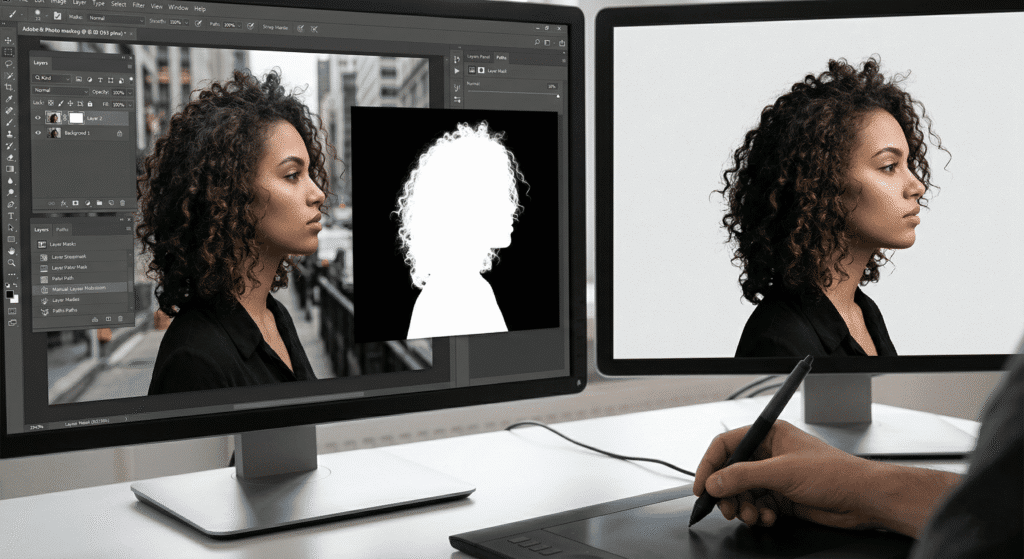
Manual photo masking utilizes human expertise and Adobe Photoshop mask layers for exact image isolation. This process guarantees premium image quality by preserving intricate details that algorithms often destroy during rapid background removal.
Manual masking is a deliberate, pixel-by-pixel process. Editors use specialized techniques, such as clipping paths and alpha channel masking, to separate a subject from its environment.
The primary benefit is the precision advantage. Human editors provide fine detail retention for highly complex elements. In our recent tests handling reflective surfaces for a jewelry catalog, we found manual edge preservation was the only way to avoid a cheap, “cut-out” look.
Ideal use cases for manual masking include:
- Luxury e-commerce product photography
- High-end fashion image editing
- Premium advertising visuals
- Isolating difficult textures like hair strands, transparent fabrics, smoke, and intricate jewelry edges.
How Does Automated Photo Masking Work?
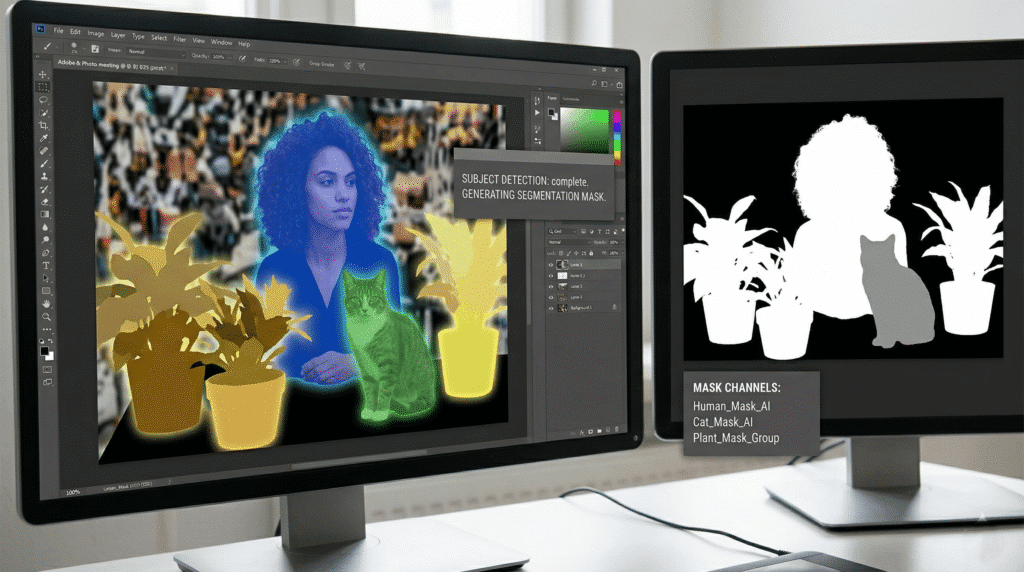
Automated photo masking relies on artificial intelligence (AI) and machine learning algorithms to detect edges and perform automatic background removal. It provides fast turnaround times and highly scalable solutions for large-scale bulk image editing.
Instead of human tracing, the technology uses trained models to analyze an image, identify the primary subject, and separate backgrounds instantly. The speed advantage is undeniable; AI software provides cost-effective bulk processing that can handle thousands of images in minutes.
However, the limitations of automation are clear when applied to complex visuals. Where AI struggles is with low-contrast boundaries, complex backgrounds, semi-transparent objects, and intricate details. The algorithms often guess incorrectly, leaving artifact edges or deleting parts of the actual product.
What Are the Key Differences Between Manual and Automated Masking?
The primary difference lies in accuracy versus speed. Manual editing delivers flawless, realistic edge preservation through human craftsmanship, while automated tools offer instantaneous, budget-friendly processing that often results in rigid, unnatural cuts.
| Feature | Manual Photo Masking | Automated (AI) Photo Masking |
| Accuracy & Detail | Flawless, realistic edge preservation; retains fine details. | Good for basic shapes; often produces rigid cuts on complex edges. |
| Speed & Scalability | Time-intensive human craftsmanship; slower scaling. | Instantaneous AI processing; excellent workflow efficiency for bulk data. |
| Cost-Effectiveness | Premium-priced due to specialized professional editors. | Budget-friendly; low cost per image. |
| Best Suited For | High-fashion, jewelry, complex transparencies. | Basic electronics, packaged goods, uniform backgrounds. |
When Should You Choose Manual vs. Automated Masking?
Opt for manual masking when fine detail retention and brand-harmonious visuals are mandatory. Choose automated tools for simple product prints requiring bulk image editing services. A hybrid approach often yields the best practical results for large operations.
- Opting for Manual: You should build your workflow around human expertise when prioritizing premium quality and working with high-value goods where the visual presentation directly correlates to the item’s perceived worth.
- Opting for Automated: This route is tested and proven for managing simple product prints (like basic electronics or boxed packaged goods) that require fast background removal.
- The Hybrid Approach: In practical production environments, the most effective method combines automated tools for initial speed with manual Photoshop masking for complex final touches and quality assurance.
Why Do E-commerce Platforms Require Professional Masking?
Major e-commerce platforms like Amazon, eBay, and Shopify enforce strict plain or transparent background requirements. Professional photo editing ensures these standards are met while simultaneously boosting sales and buyer trust through clean, distraction-free visuals.
Marketplace compliance is a structural requirement; failing to meet background specifications can result in account suspension or suppressed listings. To build high-converting catalogs, online retailers utilize a specific checklist of advanced techniques:
- Precise Clipping Paths: Creating sharp, accurate boundaries for solid objects.
- Ghost Mannequin Editing: Combining multiple photos to show how clothing fits an invisible form.
- Photo Shadow Creation: Adding realistic drop or reflection shadows to ground the product naturally.
- Color Correction: Ensuring the product matches real-world hues after isolation.
What Are the Benefits of Outsourcing Photo Editing?
Outsourcing photo editing to specialized service providers like Pixcretouch secures resource efficiency. It grants immediate access to human expertise for handling complex masking without the heavy overhead of in-house software, hardware, or training.
Managing digital marketing campaigns requires agility. By outsourcing to dedicated teams, creative agencies achieve scalability and workflow predictability. Providers like Pixcretouch can manage thousands of product images with fast turnaround times, ensuring brand consistency. Furthermore, it allows internal teams to focus on strategy rather than the tedious task of image isolation.
How Will AI and Humans Collaborate in the Future of Photo Masking?
The future of photo masking relies on blending AI efficiency with human perfection. Machine learning algorithms will handle repetitive object separation, leaving skilled editors to finalize pixel-perfect cutouts and apply nuanced judgment.
While software companies often claim one-click AI is a complete solution, production data shows a different reality. In high-end fashion quality assurance, 100% automated workflows still result in a 15-20% rejection rate. The irreplaceable human element remains structurally necessary because skilled editors possess the nuanced judgment to know when an edge looks “real” versus mathematically correct. The hybrid workflow of tomorrow dictates that AI performs the heavy lifting, and human experts provide the premium, scalable results.
FAQ
What is the cost difference between manual and automated masking?
Automated masking is highly cost-effective, often costing just pennies per image via subscription software. Manual masking requires premium pricing based on an editor’s hourly rate or a higher per-image fee due to the labor involved.
How long does bulk image editing take using AI?
AI-powered masking tools can process thousands of simple product images in a matter of minutes. However, if those images require subsequent manual quality checks, the total turnaround time will increase.
Can AI handle transparent object masking?
Currently, machine learning struggles significantly with transparent fabrics and glassware. These complex objects almost always require manual intervention to maintain realistic light refraction and background bleed.
Conclusion
Key Takeaways:
- Precision vs. Speed: Manual masking guarantees fine detail retention and premium quality, while automated tools provide unmatched speed and cost savings for simple shapes.
- Platform Compliance: High-quality image isolation is mandatory for online retailers to meet the strict background requirements of Amazon, Shopify, and eBay.
- The Future is Hybrid: The most effective modern workflows use AI for initial bulk processing and rely on human expertise for nuanced, complex refinements.
To secure flawless, competitive product images without the operational bottleneck, consider adopting a hybrid approach. Partner with specialized experts like Pixcretouch to build a scalable, high-quality visual pipeline tailored to your brand’s specific needs.