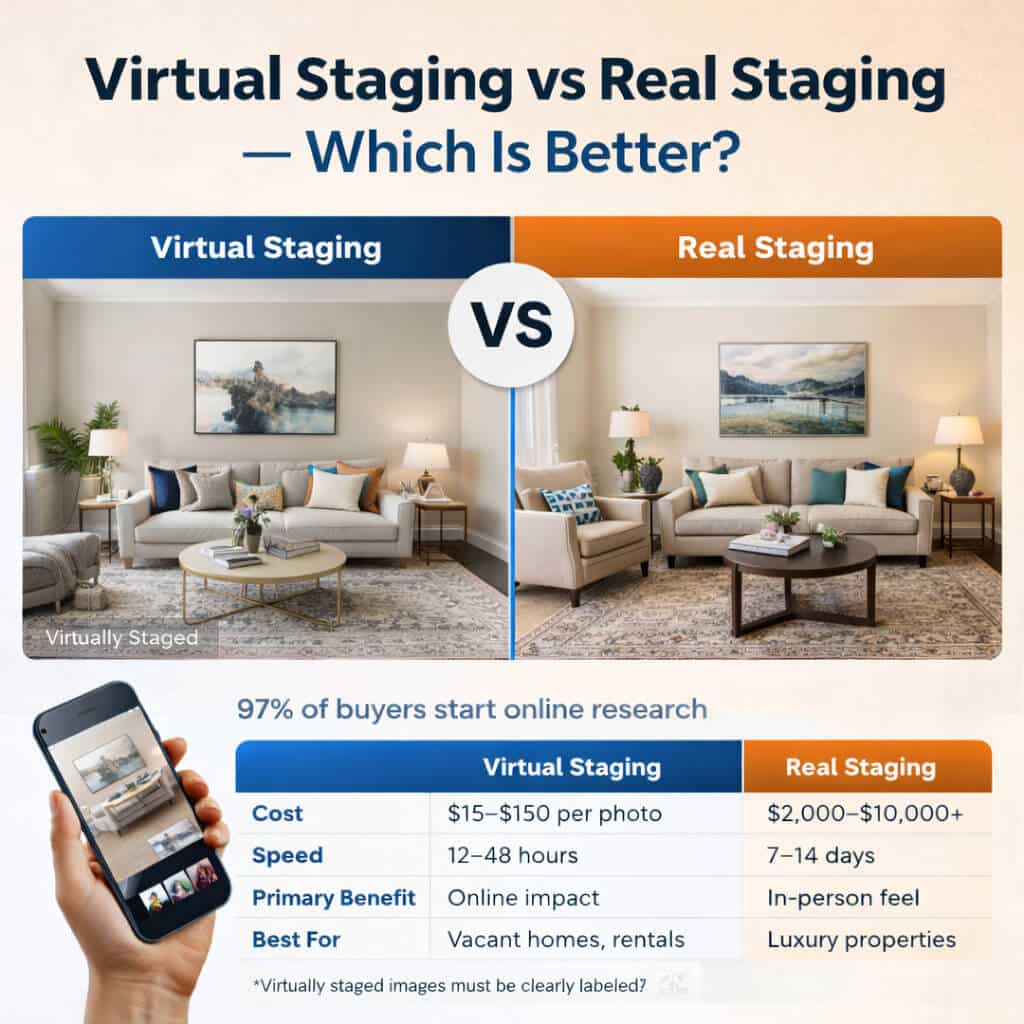
When preparing a property for sale or rent, one critical decision can dramatically impact your success: choosing between virtual staging and real staging. In today’s competitive real estate market, first impressions often occur online, where 97% of homebuyers initiate their search. The staging method you select can mean the difference between a property that lingers on the market and one that sells quickly at a premium price.
Virtual staging uses digital technology to furnish empty spaces in photographs, while real staging involves physically placing furniture and décor inside the property. Both approaches aim to help potential buyers envision themselves in the space, but they work in fundamentally different ways. This comprehensive guide examines both methods, comparing costs, effectiveness, and ideal use cases to help you make the right choice for your property.
What Is Virtual Staging?
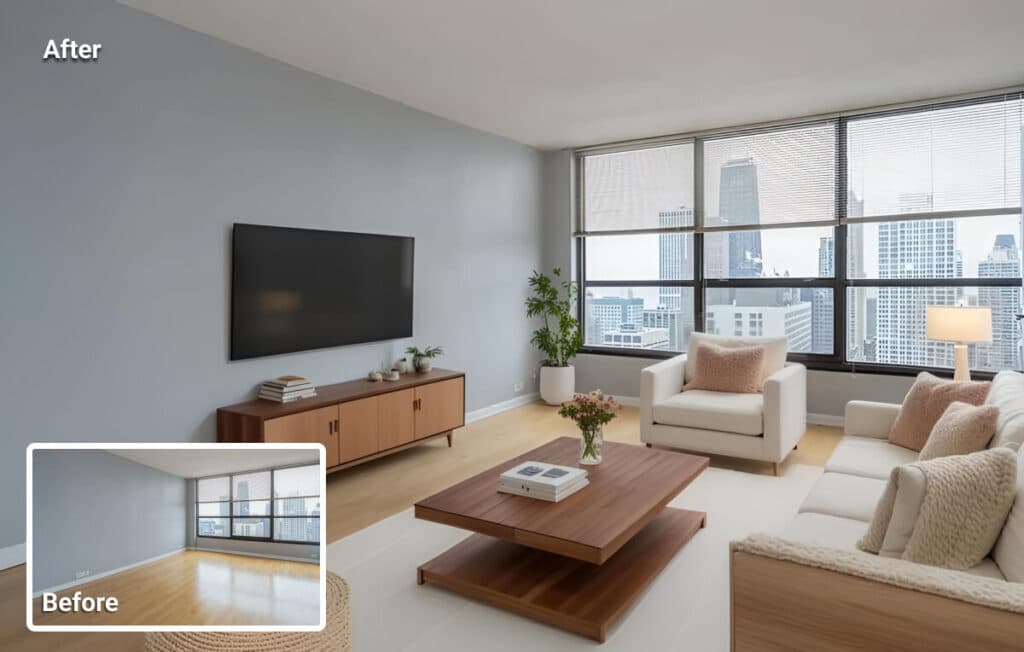
Virtual staging is a digital process where professional designers use specialized software to add furniture, décor, and accessories to photographs of empty rooms. This technology transforms vacant spaces into beautifully furnished, three-dimensional environments that showcase a property’s full potential.
The process begins with high-quality photographs of empty rooms. Professional virtual staging designers then select furnishings from extensive digital catalogs—sofas, beds, artwork, rugs, lighting fixtures, and decorative elements—and place them into the images. Modern AI-powered platforms can complete this process in as little as 24 to 48 hours, with some advanced systems delivering results in under one hour.
Common Types of Virtual Staging Styles
Virtual staging offers endless design possibilities, including:
- Modern Contemporary: Clean lines, neutral palettes, and minimalist aesthetics
- Traditional/Classic: Timeless furniture pieces with warm, inviting color schemes
- Farmhouse/Rustic: Cozy textures, natural wood elements, and vintage accents
- Luxury/High-End: Designer furnishings, premium materials, and sophisticated layouts
- Scandinavian: Light colors, functional design, and organic elements
Key Benefits Snapshot
Virtual staging delivers several immediate advantages. The cost efficiency is remarkable, with pricing typically ranging from $15 to $150 per photo compared to thousands for physical staging. Speed is another major benefit—most projects are completed within 24 to 48 hours rather than the week or more required for traditional staging. Design flexibility allows you to experiment with multiple styles to appeal to different buyer demographics. Perhaps most importantly, virtual staging creates a strong online marketing impact, which is critical since the majority of buyers make their initial property selections based on online photos.
What Is Real (Physical) Staging?
Real staging, also called traditional or physical staging, involves bringing actual furniture, artwork, and decorative items into a property to create an inviting, lived-in atmosphere. This hands-on approach has been the gold standard in real estate presentation for decades.
The process typically begins with a consultation where a professional stager assesses the property and develops a design plan. Furniture and décor are then rented or sourced, transported to the location, and carefully arranged to highlight the home’s best features. The staging remains in place throughout the marketing period, allowing potential buyers to experience the fully furnished space during showings and open houses.
How Physical Staging Works
Physical staging requires coordination among multiple parties: the stager, furniture rental companies, movers, and sometimes professional cleaners. The timeline typically spans 7 to 14 days from initial consultation to complete setup, though this can vary based on property size and complexity.
Typical Scenarios Where Real Staging Is Used
Physical staging excels in situations where in-person showings are central to the sales strategy. It’s commonly employed for luxury properties, homes in competitive local markets, properties with unique architectural features, and listings targeting buyers who prefer to experience spaces physically before making offers.
Key Benefits Snapshot
Real staging creates powerful in-person emotional connections that photos alone cannot replicate. The tactile, realistic experience allows buyers to walk through rooms, sit on furniture, and truly feel the space’s scale and flow. This physical presence enhances perceived value, often justifying higher asking prices, particularly in premium market segments.
Virtual Staging vs Real Staging: Side-by-Side Comparison
Understanding the practical differences between virtual staging and real staging helps clarify which approach best fits your needs:
| Feature | Virtual Staging | Real (Physical) Staging |
| Cost | $15–$150 per photo | $2,000–$10,000+ per project |
| Turnaround Time | 12–48 hours (minutes with AI) | 7–14 days (setup & logistics) |
| Best Property Types | Vacant homes, condos, rentals, mid-market listings | Luxury homes, unique properties, occupied homes |
| Buyer Experience | Online-only visualization | Full sensory, in-person experience |
| Marketing Effectiveness | Extremely high online engagement and click-through rates | Strong emotional impact during physical showings |
| Flexibility | Instantly change styles, layouts, or room functions | Locked into one design until the furniture is removed |
| Scalability | Can stage unlimited properties simultaneously | Limited by physical inventory and logistics |
| Maintenance | Zero ongoing maintenance | Requires cleaning, repairs, and potential replacements |
| Disclosure Requirements | Must clearly label images as virtually staged | No disclosure needed (what you see is what’s there) |
| Environmental Impact | Minimal carbon footprint | Transportation, waste, and storage considerations |
Why Virtual Staging Is Often the Better Choice
For many real estate scenarios, virtual staging offers compelling advantages that make it the preferred option.
Significant Cost Savings Compared to Physical Staging
The financial difference is striking. While traditional staging averages between $2,300 and $3,200 for most homes, virtual staging reduces this investment by up to 97%. A complete virtual staging project for a three-bedroom home might cost $200 to $400, compared to $3,000 to $5,000 for physical staging. For agents managing multiple listings or sellers working with limited budgets, this cost difference is transformative.
Faster Time-to-Market
In real estate, time equals money. Every day a property sits on the market costs the seller in mortgage payments, utilities, and opportunity costs. Virtual staging eliminates the delays associated with furniture rental coordination, delivery scheduling, and physical setup. Properties can be photographed, staged, and listed within 48 hours, allowing sellers to capitalize on optimal market timing.
Ideal for Vacant Homes, Rentals, and Remote Buyers
Empty properties often photograph poorly, appearing cold and uninviting. Virtual staging breathes life into these spaces without the expense of physical furnishings. For rental properties, where physical staging isn’t economically viable, virtual options provide professional presentation at minimal cost. Additionally, with nearly half of millennial buyers willing to make offers on homes they’ve never physically toured, compelling online photos have become essential.
High Impact on Online Listings and Engagement
Research indicates that staged photographs receive significantly more online views than unstaged alternatives. Properties with professionally staged photos attract more clicks, generate more showing requests, and create stronger first impressions. Since the vast majority of buyers filter properties online before scheduling visits, this initial visual appeal directly impacts a property’s success.
Ability to Test Multiple Design Styles for Different Audiences
Virtual staging’s flexibility is unmatched. You can create multiple versions of the same space—perhaps a home office for remote workers, a nursery for growing families, or a gym for fitness enthusiasts—and test which resonates most with your target market. This adaptability helps agents tailor marketing strategies without additional expense or physical effort.
Why Real Staging Is Better in Certain Situations
Despite virtual staging’s advantages, physical staging remains superior in specific contexts.
Strong Emotional and Sensory Impact During Showings
There’s something irreplaceable about walking through a beautifully staged home. The scent of fresh flowers, the texture of quality fabrics, the way natural light plays across carefully arranged furniture—these sensory details create emotional connections that digital images cannot replicate. This visceral experience often triggers the gut feeling that leads buyers to make offers.
Helps Buyers Understand Room Scale and Layout
Even the most sophisticated virtual staging can’t perfectly convey spatial relationships. Physical staging allows buyers to stand in rooms, understand traffic flow, and mentally place their own belongings. This tactile exploration builds confidence in the space’s functionality and reduces uncertainty about whether the home meets their needs.
Reduces Buyer Disappointment During In-Person Visits
One legitimate concern with virtual staging is the potential gap between photographed expectations and physical reality. When buyers arrive at a virtually staged property and find empty rooms, some experience disappointment or feel misled, even with proper disclosure. Physical staging eliminates this risk—what buyers see online matches exactly what they’ll experience during tours.
Preferred for Luxury Homes and Premium Listings
In high-end real estate markets, buyers expect a certain level of presentation. Physical staging signals quality, attention to detail, and professionalism. For properties priced above $1 million, the investment in real staging often pays dividends through higher offers and faster sales. Luxury buyers, accustomed to premium experiences, respond positively to the tangible quality that physical staging provides.
Limitations of Both Staging Methods
Both approaches have drawbacks worth considering.
Virtual Staging Drawbacks
The primary concern with virtual staging revolves around disclosure and buyer expectations. Real estate professionals must clearly indicate when images are digitally enhanced. Most MLS organizations require explicit labeling, such as “Virtually Staged” watermarks or prominent disclaimers in listing descriptions. Failure to disclose can damage trust, generate complaints, and even result in legal issues.
Another limitation is that virtual staging cannot show the true physical feel of the space. Buyers may fall in love with photos only to feel underwhelmed when visiting the empty property. This expectation gap can slow the sales process if not managed properly.
Real Staging Drawbacks
The most significant limitation of physical staging is the high upfront investment. For many sellers, spending $3,000 to $10,000 on staging represents a substantial financial commitment, particularly if the home doesn’t sell quickly or if market conditions are uncertain.
Longer preparation time is another challenge. Coordinating staging professionals, scheduling furniture delivery, and completing setup takes significantly more time than uploading photos for virtual staging. This delay can be problematic in fast-moving markets or when sellers face time pressure.
Limited design flexibility once installed means that if the initial staging doesn’t resonate with buyers, making changes requires additional logistics and expense. Unlike virtual staging, where design adjustments take hours and cost little, physical restaging involves removing and replacing furniture—a time-consuming and costly process.
The Hybrid Staging Approach: Best of Both Worlds
Smart real estate professionals increasingly embrace a hybrid strategy that combines virtual and physical staging to maximize effectiveness while controlling costs.
Why Many Agents Combine Virtual and Real Staging
The hybrid approach recognizes that buyers move through distinct stages in their property search. Initial online browsing favors properties with compelling photos, while in-person tours create the emotional connection needed to generate offers. By using virtual staging for comprehensive online presentation and physical staging for strategic in-person impact, agents capture the benefits of both methods.
How Hybrid Staging Maximizes Return on Investment
A typical hybrid strategy might virtually stage all rooms for online listing photos while physically staging only the living room, primary bedroom, and one additional high-impact space for showings. This approach significantly reduces costs compared to full physical staging while maintaining professional presentation throughout the property.
For example, instead of spending $6,000 to physically stage an entire home, an agent might invest $1,500 to physically stage key rooms and $300 to virtually stage the remaining spaces for photography. This balanced approach delivers professional presentation across all marketing channels at less than one-third the cost of complete physical staging.
Practical Example: Virtual Staging for Online Listing Photos, Physical Staging for High-Impact Rooms
Consider a four-bedroom home with a kitchen, dining room, living room, family room, and primary suite. A hybrid approach might include:
- Virtual staging for all rooms in listing photography ($400 for 8 images)
- Physical staging for the living room and primary bedroom only ($1,800)
- Total investment: $2,200 (compared to $5,000+ for full physical staging)
This strategy ensures outstanding online presentation while providing memorable in-person experiences in the spaces that matter most to buyers.
Importance of Transparency and MLS Compliance
Regardless of the staging approach, transparency is non-negotiable. All virtually staged images must be clearly labeled. Most MLS systems require specific disclaimers, and professional standards demand honest representation. Agents should include both virtually staged photos for visual appeal and unstaged photos for transparency, allowing buyers to see the actual condition of spaces.
How to Choose the Right Staging Option
Selecting the optimal staging method depends on several key factors specific to your situation.
Budget Considerations
Your available budget heavily influences the staging decision. If you have $500 to $1,000 available, virtual staging provides excellent value and comprehensive coverage. With $2,000 to $3,000, hybrid staging becomes viable. Budgets exceeding $5,000 open the door to full physical staging for premium properties where this investment is justified by higher sale prices.
Property Type and Condition
Vacant properties benefit immensely from virtual staging, which costs a fraction of furnishing empty rooms physically. Occupied homes with outdated furniture might benefit from a combination approach—virtual staging to show potential and selective physical staging to update key areas. New construction and luxury properties typically warrant physical staging to match buyer expectations in those market segments.
Buyer Behavior: Online-First vs In-Person
Understanding your target market’s buying behavior is crucial. Millennial buyers, who represent a significant portion of today’s market, conduct extensive online research and often make decisions based primarily on photos and virtual tours. This demographic responds exceptionally well to virtual staging. Conversely, older buyers or those purchasing luxury properties often prefer comprehensive in-person experiences, making physical staging more valuable.
Listing Timeline and Urgency
If you need to list quickly—perhaps due to relocation, financial constraints, or market timing—virtual staging’s 24 to 48-hour turnaround is invaluable. Properties that will remain on the market for extended periods might justify the longer setup time for physical staging, particularly if they’re in price ranges where presentation significantly impacts final sale prices.
Future of Home Staging
The staging industry continues to evolve rapidly, driven by technological advancement and changing buyer preferences.
Growing Role of AI and Digital Staging
Artificial intelligence is transforming virtual staging capabilities. Modern AI-powered platforms can now stage rooms in under 30 seconds with photorealistic results that rival traditional photography. Machine learning algorithms analyze room dimensions, lighting conditions, and architectural features to place furniture with accurate scale and perspective. This technology democratizes professional staging, making it accessible to individual sellers and small agencies who previously couldn’t afford comprehensive staging services.
Increased Focus on Online Presentation
As online property search becomes increasingly sophisticated—with 3D tours, virtual reality walk-throughs, and interactive floor plans becoming standard—the importance of exceptional online presentation continues to grow. Properties with subpar online presence face significant disadvantages, as buyers eliminate options before ever visiting in person.
Buyer Expectations for Transparency and Realism
Today’s buyers are savvy digital consumers who expect honesty and authenticity. While they appreciate professional presentation, they’re also wary of misleading marketing. The future of staging lies in balancing aspirational presentation with truthful representation. This means clear disclosure, high-quality staging that accurately reflects spaces, and providing both staged and unstaged images when appropriate.
Frequently Asked Questions
Is virtual staging misleading?
Virtual staging is not misleading when properly disclosed. Real estate professionals must clearly label virtually staged images and include unstaged photos in listings. Most MLS systems require specific disclaimers, such as “Virtually Staged” watermarks or prominent notes in property descriptions. When used transparently, virtual staging helps buyers visualize a property’s potential without deception. The key is honesty—never present digitally enhanced images as actual photographs of physically staged spaces.
Does staging really help homes sell faster?
Yes, research consistently shows that staged homes sell faster than unstaged properties. Data from the Real Estate Staging Association indicates that staged homes sell approximately 73% faster than their unstaged counterparts. The National Association of Realtors reports that 83% ofbuyer’s’ agents say staging makes it easier for buyers to visualize properties as their future homes. Staged listings generate more online views, attract more showing requests, and create stronger first impressions—all factors that accelerate the sales process.
Is real staging worth the cost?
For many properties, particularly those in luxury markets or unique price points, real staging absolutely justifies its cost. Studies suggest that staged homes can sell for 5% to 10% more than unstaged properties. On a $400,000 home, a 5% increase represents $20,000 in additional proceeds—far exceeding typical staging costs of $2,000 to $5,000. However, the value proposition depends on property type, market conditions, and buyer demographics. In budget-conscious situations or for mid-market properties, virtual staging often provides better return on investment.
Can virtual and real staging be used together?
Absolutely. The hybrid approach, which combines virtual and real staging, is becoming increasingly popular among successful real estate professionals. This strategy uses virtual staging for comprehensive online photography while physically staging key rooms for in-person showings. This maximizes online appeal to generate showing requests while providing authentic, impressive in-person experiences for serious buyers. The combined approach typically costs less than full physical staging while delivering a professional presentation across both digital and physical channels.
Is virtual staging better than real staging?
Neither virtual nor real staging is universally “better”—each excels in different scenarios. Virtual staging offers superior cost-efficiency, speed, and flexibility, making it ideal for vacant homes, tight budgets, and online-focused marketing. Real staging provides irreplaceable in-person emotional impact, perfect for luxury properties and buyers who prioritize physical touring. The best choice depends on your specific property, target market, budget, and timeline. Many successful listings use both methods strategically to capture the benefits of each approach.
Does virtual staging help sell homes?
Yes, virtual staging significantly helps sell homes by improving online presentation and generating buyer interest. Research shows that professionally staged photos receive substantially more online views than unstaged images. Since 97% of buyers begin their search online, creating strong first impressions through quality photographs is critical. Virtual staging transforms empty, cold-looking spaces into inviting, aspirational environments that help buyers envision themselves living in the property. This increased engagement translates to more showing requests and ultimately faster sales.
Final Verdict: Virtual Staging vs Real Staging
The question of virtual staging vs real staging doesn’t have a single answer—it depends entirely on your specific situation, goals, and resources.
Virtual staging excels for budget-conscious sellers, vacant properties, rapid marketing timelines, and online-focused buyer markets. Its cost-efficiency, speed, and flexibility make it an excellent choice for the majority of residential listings, particularly in mid-market price ranges.
Real staging remains the gold standard for luxury properties, homes with unique architectural features, and markets where in-person showings drive purchasing decisions. The emotional impact and authentic experience justify the higher investment when targeting buyers who expect a premium presentation.
The most sophisticated approach combines both methods strategically. Use virtual staging to create compelling online presence across all property spaces, while investing in physical staging for key rooms that create the strongest in-person impressions. This hybrid strategy maximizes return on investment while providing professional presentation across all buyer touchpoints.
Ultimately, successful staging—whether virtual, physical, or hybrid—comes down to understanding your property, knowing your target buyer, and presenting your home in the most appealing, honest, and effective way possible. The best choice is the one that helps your property stand out, generates genuine buyer interest, and leads to a successful sale at the best possible price.